
Collectors don’t chase every vintage brooch, and a label that says "vintage" tells you very little. So how can you tell which pieces are worth a closer look?
In this article, we’ll go through the styles collectors want most and show you how to recognise each one by its era, its materials, its maker’s marks and its clasp.
Vintage brooch styles collectors seek first, and what sets each one apart
Collectors don’t chase every style. They focus on a few, and each has its own era and materials. Start with the cameo.
A cameo shows a portrait or scene raised in relief, often carved from shell or layered hardstone like agate. Sweetheart brooches copy military badges in miniature, worn in the First World War and seen again in the Second.
Edwardian pieces (1890 to 1920) have lace-like platinum work, bows and slim bars. Art Deco (1920 to 1935) has geometric shapes and contrasting stones. Mid-century brooches show animals and insects.
For a modern take on the look, see the Three Running Horses Vintage-Style Brooch. Don’t trust "vintage" alone: judge the piece by its marks, not its label.
Cameo brooches: the most recognisable style of the past
Shell and hardstone cameos
A cameo’s design rises in relief above its background. An intaglio is the reverse: the design is cut down into the stone, so the surface looks hollow.
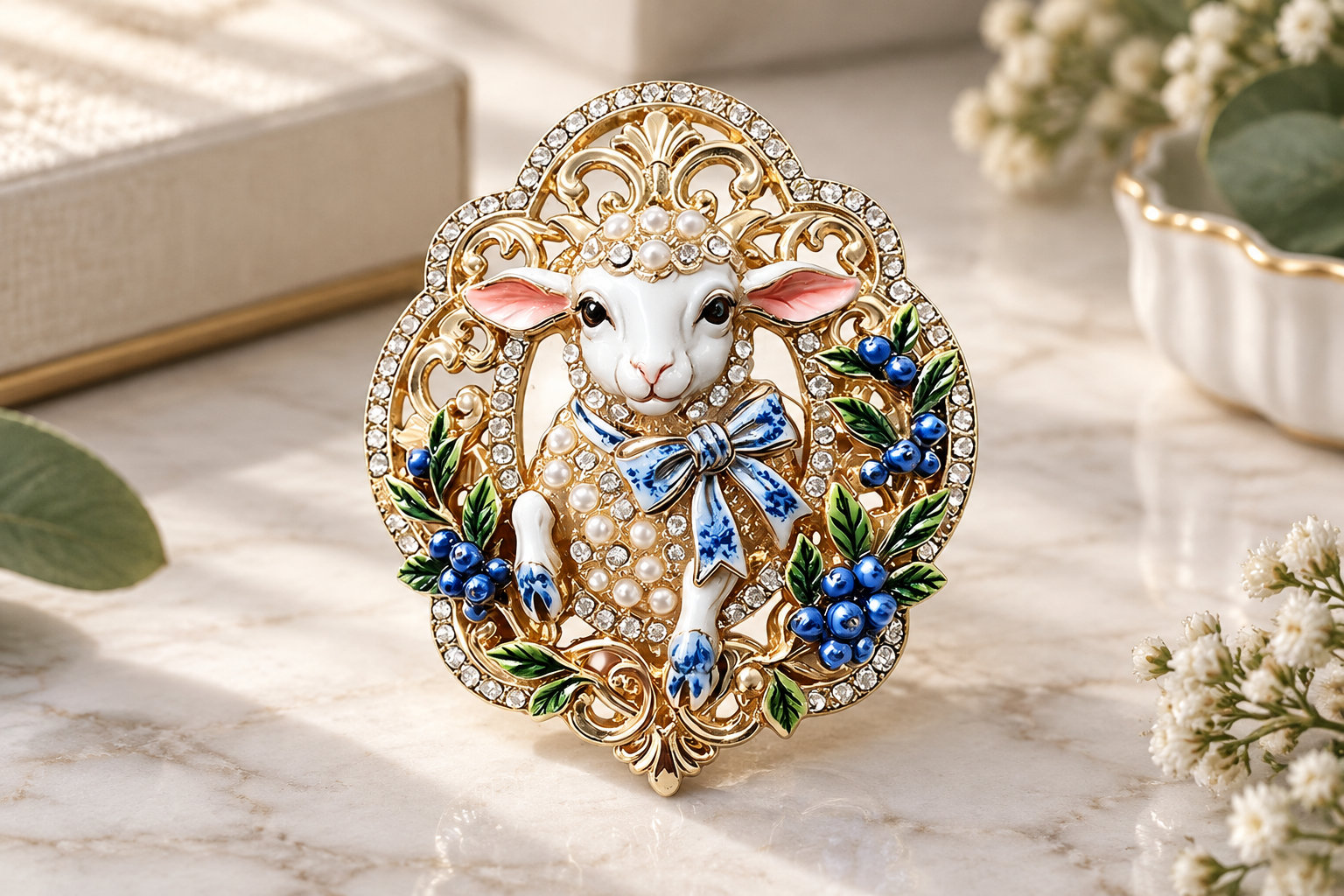
Most antique cameos are carved in shell or hardstone. Hardstone examples use layered stone like agate, sardonyx or onyx.

Sellers mix these up more often than they should. Check the relief yourself before you buy.
Want to tell a shell cameo from a hardstone one? Three quick checks in your hand are enough.
| Check | Shell cameo | Hardstone cameo |
|---|---|---|
| Held to a light | Glows pink, orange or cream, with curved growth lines | Stays opaque, with no glow |
| Weight and feel | Lighter and warmer to the touch | Heavier and colder to the touch |
| Back | Often follows the curve of the shell | Usually flat |
Intaglios and cameo-look pieces
Hold it under a lamp and look for bubbles or a mold seam. Bubbles point to molded glass, while a seam or an even, smooth surface points to resin or plastic.
Fine Victorian shell cameos in 15- or 18-carat frames run about $300–$1,200. For a modern piece, see the Sculptural Swirl Circle Brooch by Brooch Paradise.
Sweetheart brooches carried sentiment from the front lines
Wives, sisters and girlfriends pinned sweetheart brooches on during the First World War to show a loved one’s unit.
Silver ones may carry a date hallmark, and 1915 is common. Never skip that mark: it’s the fastest way to date one.
Look for these on a sweetheart brooch:
- A miniature regimental cap or ship badge, copied small enough to wear.
- Anchors, crossed swords, rifles or horseshoes, each one tied to a unit or service.
- Brass, silver, gold, enamel or mother-of-pearl, sometimes mixed in one pin.
Check the back for maker’s marks and the pin fitting. Then match the British date letter with its assay-office mark, lettering and shield shape. A design used in several wars won’t name the conflict.
Art Deco and Edwardian brooches: light, geometric and often convertible
Edwardian lightness
Edwardian brooches are light. Look for platinum settings holding small diamonds, pearls or coloured stones, often so fine the metal nearly disappears. Bows, wreaths, garlands and slim bars are common shapes.
Don’t date by the king’s name. The style is often dated 1890 to 1920, while King Edward VII reigned only from 1901 to 1910. Treat a heavy, chunky piece sold as Edwardian with suspicion.
Art Deco geometry and convertible clips
For a plain geometric outline to compare with, see the Polished Domed Circle Brooch, then look for these signs:
- Straight lines, stepped shapes and angular blocks, the usual Art Deco look.
- Contrasting coloured stones, often set in platinum with diamonds.
- Two matching halves. Count both clips and check that they fit the frame.
- A double-clip brooch joins into one piece or splits into two clips for your clothes.
Check the back or pin stem for a metal mark: PLAT or a gold-carat mark on British pieces, a dog’s head (platinum) or an eagle’s head (gold) on French ones.
A pin running past the brooch’s edge can point to an older style.
A small loop or hidden bail means it was also made to hang as a pendant.
Mid-century novelty brooches picked animals, insects and everyday objects
Mid-century novelty brooches stand out in three dimensions: the animal or insect is sculpted, not flat. Trifari’s "jelly belly" animals used a clear Lucite centre, so look for a see-through body.
Related Products


For a sculpted insect, compare the Abalone-Look Butterfly with Rhinestone Drops with flat pieces.
Pass on any flat animal sold as mid-century unless its form is clearly sculpted.
Before you buy a Coro Duette
- Check that the frame is there and not broken or bent.
- Check that both dress clips are present and match in design and finish.
- Open and close each clip to make sure its spring works and holds.
- Clip both pieces to the frame, then separate them, to confirm the set wears both ways.
Pastel crystal and pearl brooches capture the bright 1950s and 60s
Pastel crystal and faux-pearl brooches are the bright pieces of the 1950s and 60s.
Look for the Aurora Borealis finish, a thin metallic layer with a rainbow sheen. It appeared on rhinestones from about 1956. Turn it over: foil on the back matters, so skip pieces with peeling or cloudy backs.
Water, sweat, perfume and cleaning liquids can seep behind the glass and cloud the foil. That damage is permanent, so wipe the stones with a dry cloth and never dunk the brooch in water.
Check each setting before you buy, too: a gap around a stone lets moisture in.
Clasps, marks and condition decide what a brooch is worth
Clasps as dating clues
A C-shaped catch and a tube hinge can point to a frame made before 1900. A safety catch can point to one made after 1910. Is yours a safety catch?
These fittings are clues, not proof of age. Reproductions can copy any clasp, so check the marks and condition too. Don’t pay an antique price for a catch alone.
Marks, materials and condition checks
Turn it over and read the marks:
- A British date letter needs its assay-office mark, its typeface and the shape of the shield. One letter alone can match more than one year.
- Costume makers often stamp their name on the back. Read the name and any patent number, then check a mark reference.
- A mark can name the maker or the metal. It does not prove the brooch is original, so check the whole piece.
Check before you buy
- Check that the pin is straight and lies flat on the back.
- Open and close the hinge; it should feel firm.
- Snap the catch shut; it should close firmly.
- Count the stones and look for empty settings.
- Hold it to a light and look for cracks, chips and worn plating.
- Ask the seller about repairs or a replaced frame.
Start with one style, not all of them. Learn its era, material and marks, and a label saying "vintage" matters much less.
Your next step: pick one style from this list and look at three pieces of it. Turn each one over and read the marks before you check the price.
Frequently Asked Questions
What years are considered vintage for jewelry?
Jewelry is vintage when it is at least 20 years old and less than 100. That’s a wide window, so a brooch from the 1990s already counts. Anything older than 100 years is usually called antique.
Are old brooches worth anything?
Yes, some are. A brooch can be worth money because of its metal, its stones, its maker, its age, its condition and collector demand.
Before you judge one, check its marks and fittings, since they tell you more than the label does.
Are brooches on trend right now?
You don’t need a trend to wear a brooch. If you like the look, pin one to a lapel, a scarf or any other piece of clothing. Choose one that suits your style, and wear it the way you want.
0 commentaire