
No flower has one fixed meaning. Victorian guides even disagreed about the rose: beauty for one, love for another.
So what does your brooch really say to the person who gets it? This article shows what each flower, colour and motif stands for, where those meanings come from, and how to choose or give one so the message lands.
Meaning of flower brooches: one flower, several possible messages
A flower brooch can suggest a feeling through its flower and colour. But no flower has one fixed meaning, and Victorian guides disagreed: one called the rose beauty, another called it love.
For a flower that looks pretty without shouting a message, check the snowflake brooch with pearl-look petals. Honestly, a brooch that gets a compliment is already doing its job.
Flower-language books were popular, but they never agreed on what each bloom meant. So a flower brooch is only a hint, not a sure message.
If the message matters to you, add it in words: a short note, or one sentence when you hand the brooch over.
The traditional language of flowers, and what each bloom stood for
Rose, lily and violet
Victorian flower guides gave the rose a few readings. A red rose meant love, and any rose could stand for beauty. A white rose was read as innocence or silence.
The white lily usually meant purity, and the violet meant modesty. Some guides linked blue violets with love instead.
Don’t count on the old code: if your recipient has never heard of it, the brooch simply looks pretty, and that’s enough.
Pansy, honeysuckle and carnation
Three more flowers carry their own short messages:
- Pansy: "you occupy my thoughts," from the French pensées, meaning "thoughts." For that message, start with the Sparkling Heart Flower and Butterfly Motif Brooch.
- Honeysuckle: devoted affection, the steady kind that lasts.
- Carnation: pride and beauty. A striped one traditionally means refusal, so check the stripes before you give it.
Quick reference
Pansy
- Victorian meaning: "you occupy my thoughts"
- Name comes from French pensées, "thoughts"
- Modern guides: loving thoughts
Honeysuckle
- Devoted affection, the steady kind that lasts
- Modern guides: devoted affection
Carnation
- Victorian meaning: pride and beauty
- Striped: refusal, so check the stripes first
- Modern guides: love or remembrance
How colour shifts the message a flower brooch sends
Red, white and pink
Red roses traditionally mean love, but red flowers can carry other meanings too. So the flower matters as much as the colour.
White roses have stood for innocence, silence and "I am worthy of you." Pink ones mean grace and joy in one Victorian-style guide.
Don’t pick a rose by colour alone. Check the flower too.
Yellow, the most variable colour
Yellow is the colour where the two readings split the most.
| Criterion | Victorian flower language | Modern flower guides |
|---|---|---|
| What yellow roses mean | Infidelity, or a decrease of love | Friendship, happiness or joy |
| Kind of message | A message about lost love | A warm, cheerful message |
| Gift risk | High, if the receiver knows the old code | Low, if the receiver reads modern guides |
Colour alone doesn’t tell you the message. Yellow roses can mean joy in one guide and infidelity in another, so check the flower type and the setting before you decide.
For a large, clearly shaped flower, see the Openwork Textured Petal Flower Brooch from Brooch Paradise and pick the message from the whole design.
Where flower symbolism came from: French and English flower guides
The first big French flower guide came out in 1819. Louise Cortambert wrote it as Charlotte de Latour, and it gave meanings for about 300 flowers.
England followed in 1825 with Henry Phillips’s Floral Emblems. Honestly, readers on both sides of the Channel couldn’t get enough of these books.
Guides gave readers a shared vocabulary, not a universal code. Writers often disagreed, so a rose could mean different things in different books.
Bouquets were rarely planned as exact messages. For a light gift, see the hedgehog holding a daisy brooch.
Pick the flower you love, and count any message as a bonus.
Why brooches have carried meaning: love tokens, mourning and status
Keepsakes, love tokens and mourning jewellery
Hair in a brooch doesn’t automatically mean grief. From the second half of the 18th century, jewellers and miniaturists wove human hair into brooches, and it could come from a living loved one.
Check the inscription, which can mark a piece as mourning jewellery or as a love token. Without one, plaited hair can celebrate friendship as well as loss, so don’t assume grief from hair alone.
Hair or words: which one tells the story?
A hair brooch, around 1754
- It holds a lock of hair.
- Its inscription names Elizabeth Eyton and her death.
- It is a clear mourning piece.
A gold heart brooch, around 1400–1425
- Made in England or France.
- Its inscription reads "Without being parted."
- It speaks of love, and it has no hair.
Status, protection and luck
Brooches also showed rank and wealth. A gold flower brooch from around 1400–1450 set diamonds and a central spinel, so its stones showed what its owner could afford.
Those gems belonged to that one piece, not to every flower. For a big bloom picked for looks, try the large layered flower with blue and green petals.
Pick the look first, and add a message only if you can name it.
Choosing a flower brooch as a gift, and making the message clear
Start with the message, then pick the flower. A red rose says romance to almost everyone. A pansy means "you are in my thoughts," and honeysuckle stands for devoted affection.
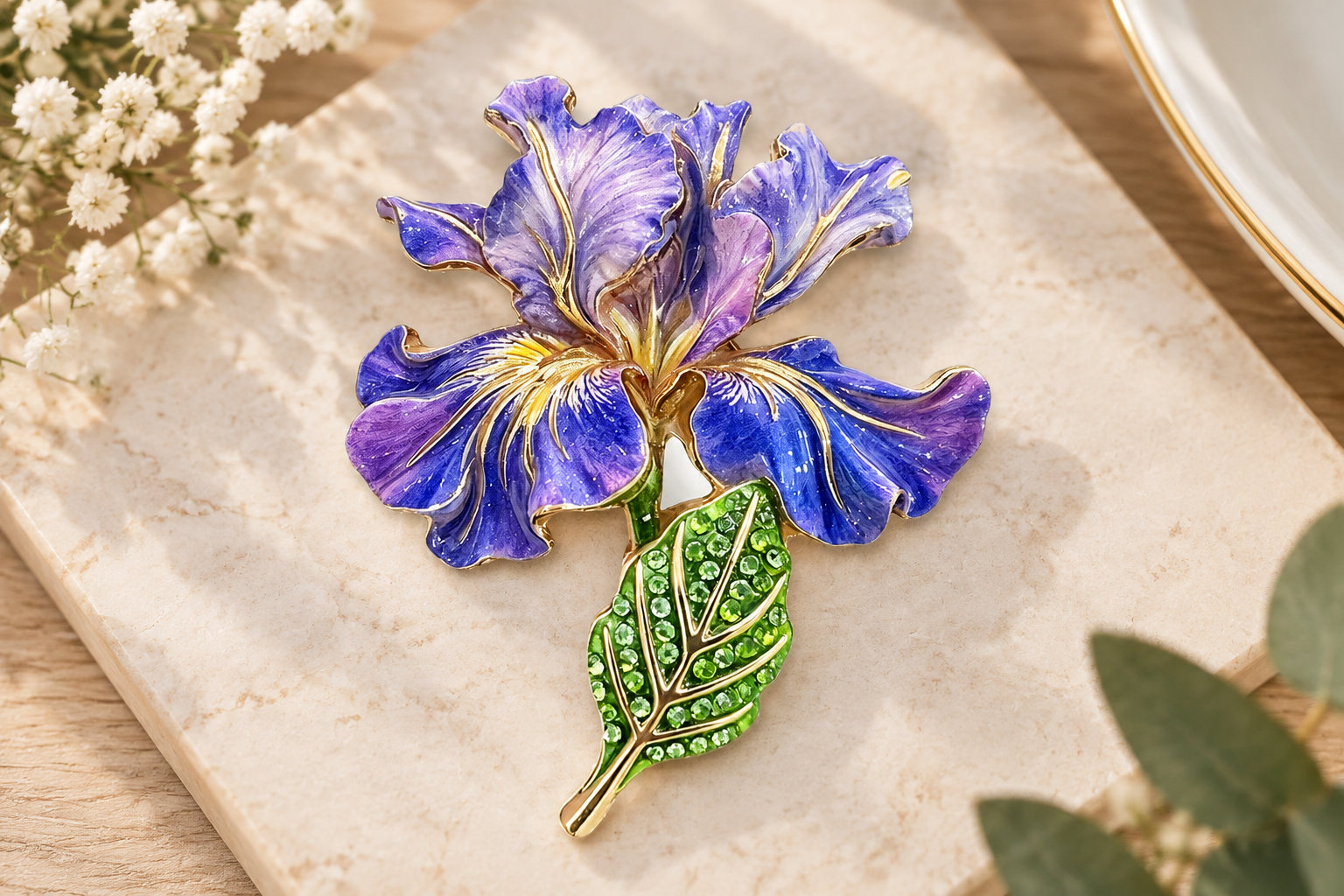
Meanings differ between guides, so add a short note if you want your brooch understood. Give the rose to a partner and the pansy to a friend.

Check size and care first:
- For a bouquet, see enamel flower bouquet.
- Iris Stem: 6.2 × 5 cm, 14.6 g. Vintage Oval: 6.3 × 4.8 cm, 29.1 g.
- Pin it to a lapel, scarf or bag. Keep it dry, away from perfume.
- For a flower with wings, see hummingbird brooch.
- For a basket of blossoms, see pumpkin flower basket brooch.
Choose the flower you love first. A rose, a pansy or a honeysuckle can carry a message, but only if the person knows the code. Most people will just see a pretty brooch, and that’s enough.
If the message matters, say it in words: a line on a card, or one sentence when you hand the brooch over.
Frequently Asked Questions
Which flower stands for love in flower language?
The red rose stands for love in flower language. It has traditionally meant love, so most people reach for it first. Still, it is a tradition, not a rule, so say the message in words if it matters to you.
Does a yellow rose always mean jealousy?
No, a yellow rose doesn’t always mean jealousy. Some Victorian guides link it to a decrease of love or to infidelity, but flower meanings are not fixed, so check the setting before you decide what the brooch says.
Were flower brooches used as mourning jewellery?
Yes, some were. A mourning brooch could hold a loved one’s hair and carry a memorial inscription, which is how it kept that person close. Without the inscription, though, hair alone doesn’t prove grief.
What does a pansy brooch mean?
A pansy brooch can mean "you occupy my thoughts." It’s a gentle way to tell someone they have been on your mind.
Flower meanings aren’t fixed, though, so if that message matters to you, add a short note saying it in words.
0 comments