
Cameos started with Greek carvers who raised the figure out of the stone. Yet a brooch that looks old can be a recent piece, so how do you tell what you’re buying?
This article follows cameos from ancient gems to Victorian jewellery and later revivals, and shows what to check before you buy.
Cameo brooch history begins with ancient carved relief
Cameos began with Greek carvers around the fifth century BCE. They cut the figure in raised relief, so it stands out from the stone. Earlier gems were cut inward, a method called intaglio.
Tilt it under a lamp. The raised figure throws a shadow, while an intaglio’s lines sink into the stone. Ask for a side view before you buy.
Sardonyx has bands of different colours. A carver could cut the figure from a pale layer and leave a darker layer as the background, so the picture stands out. That’s why this stone suited raised figures.
Roman glassmakers copied the trick. They laid up coloured glass layers and carved them to imitate those hardstone bands. When you see two clean colour bands in one piece, you’re looking at either stone or glass made to look like it.
Renaissance collectors brought the cameo back into fashion
Collectors brought the cameo back. By the early fifteenth century, Italian humanists were hunting ancient gems again, and Pope Paul II was among them.
Lorenzo de' Medici went further: he backed new carving in Florence, so his cabinet mixed old gems with fresh ones. Honestly, that’s where the classical look stopped being a relic and became a fashion.
Cameo images travelled beyond the original stones in four ways:
- Copies: Lorenzo’s Florentine workshops made copies of a famous gem around 1490.
- Bronze plaquettes: cast from carved gems, they cost collectors less.
- Grand Tour: British travellers met cameo collections in Rome.
- Wedgwood: the Staffordshire firm sold copies, including a design based on the Marlborough Cameo.
Why the Victorian era made cameos a jewellery staple
Shell carving for a wider market
By mid-century, shell had taken over. Italian and French workshops carved more cameos from shell than from hardstone. The reason is simple: shell is quicker and cheaper to cut.
Less time at the bench meant a lower price. That opened the door to buyers who were never wealthy collectors of ancient gems. Travellers took shell cameos home from Italy as souvenirs. Good news for anyone on a modest budget.
Sentimental and portrait cameos
Shell made stories easy to sell. An Italian shell cameo from 1810–20 shows cupids, doves and an altar of love. Such a brooch could say you loved a partner, missed a friend or grieved someone.
Then came royalty and books. Félix Dafrique, a French jeweller, made a cameo of the young Queen Victoria in 1851, linked to the Great Exhibition. An English brooch from about 1840 shows Ariel from Shakespeare’s The Tempest.
Pick the scene you already love, because that is the one you will actually wear.
What a cameo brooch said about its wearer
A cameo never meant the same thing twice. A Roman ring showed wealth and taste, or devotion to a god, and the wearer decided what it said.
Victorian buyers used cupids, doves and butterflies to say love, loyalty or grief. Want the right message? Pick the motif first. Honestly, a dove says more than a card could.
Brooches that held a person
English brooch, about 1850
- Glazed compartment on the back
- Held hair or a small image
- Kept as a private keepsake of a loved one or someone who had died
French cameo, about 1872
- Portrait of Carl Rudolf Brunnarius
- Father-in-law of carver Jean Georges Bissinger
- Made as a memorial
Shell, agate and coral each gave cameos a different character
Hardstone takes longer to carve, and that slow work is much of its prestige. Agate and sardonyx have colour bands, so a pale figure on a dark ground stands out sharply.
Shell is quicker and cheaper to cut, so it never carried the same status. Choose hardstone if you want a piece that shows the time spent on it.
Shell, coral and agate each gave the cameo its own character.
| Criterion | Shell | Coral | Agate |
|---|---|---|---|
| Material | Helmet shell | Coral | Layered agate |
| Feature | Pale figure on a darker background | Gold mounts, hung with pearls | Portrait subject |
| Example | Nineteenth-century carvings | Froment-Meurice set, Paris, about 1854 | Bissinger brooch, about 1872 |
Cameos faded from fashion, then returned in new forms
By the 1860s, Neoclassical taste was fading. Designs were repeated, counterfeits flooded the market, and the work grew weaker. Later revivals came and went, but none matched the Neoclassical originals.
Enjoy a revival for how it looks, but don’t pay Neoclassical prices for one.
The choker portrait became so common that it tired buyers of the style. Later revivals have no firm dates or styles to tie them to, so the look of a brooch can’t prove its age.
Judge the carving and the material you can see. If a seller asks a vintage price on looks alone, you may be paying for a recent piece.
Today’s cameo brooches still carry a personal story
Modern cameos keep the old method: a raised figure set on a contrasting background, now in everyday metal.
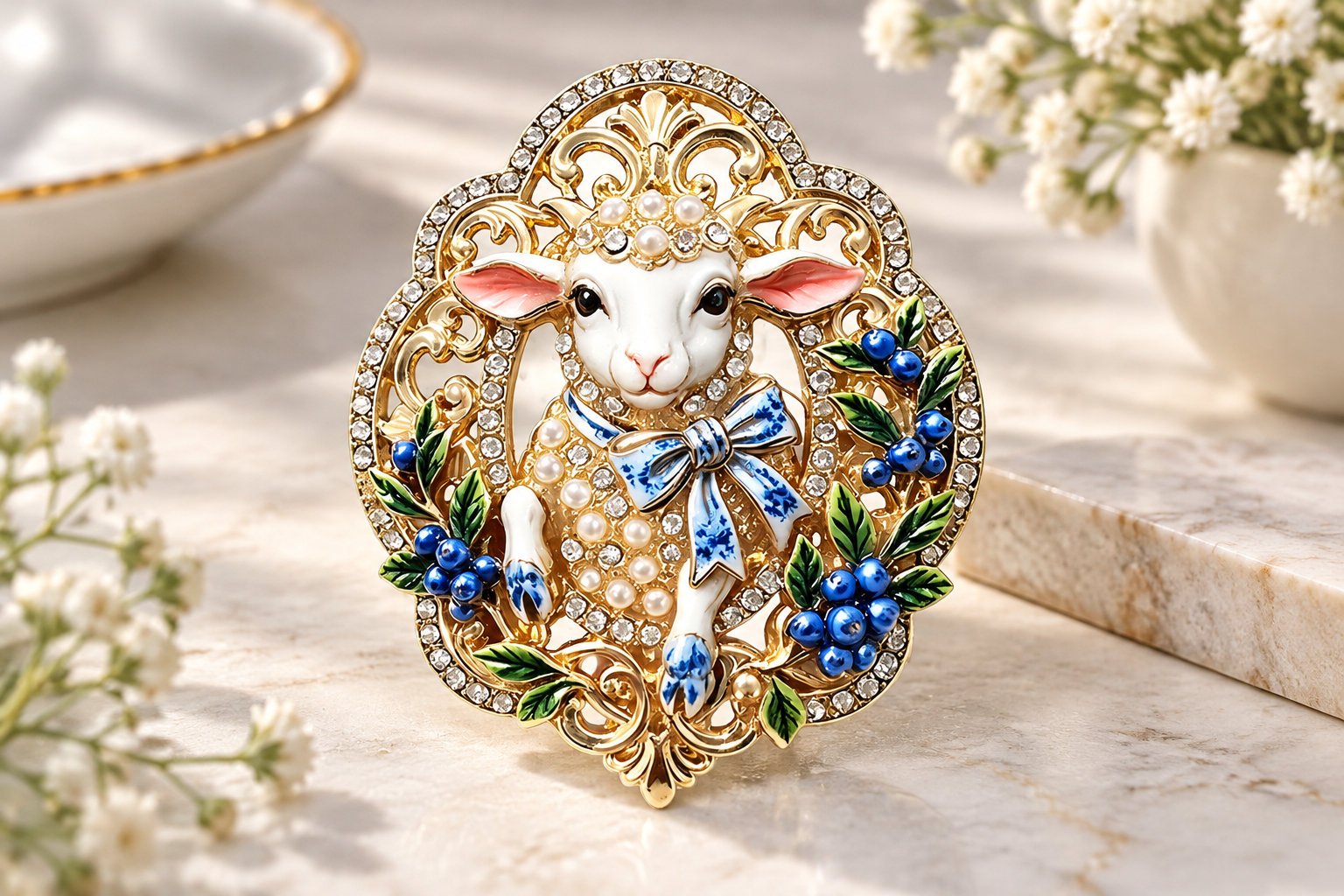
For a motif with personal meaning, browse the botanical and animal designs before you choose. Some people will laugh at a sheep on a brooch, so pick an animal only if your recipient will smile at it.

Before you buy or give
- Check the material named in the listing: shell, hardstone, glass or synthetic. The care needs depend on it.
- Hold the brooch by its metal frame, not by the sheep portrait.
- Follow the care advice supplied with the product.
- Decide whether the sheep means something to the recipient, such as a love of farm animals.
Here’s the short version: a cameo is a figure carved to stand out from its background. Its meaning has changed each time someone wore one.
Your next step is simple: check the material and the carving, then pick a motif that means something to you, or to the person you’re giving it to. Picking the motif is the fun part.
FAQ
Are cameo brooches still made today?
Yes, contemporary artists still carve cameos. Shinji Nakaba’s Peace Brooch dates to 2011, so a carved brooch can be recent work, not only an antique.
When you shop, ask the seller whether the piece is old or new, because the answer changes what you should pay.
How can you tell a shell cameo from a hardstone one?
Check the visible layers: clear color bands mean hardstone, such as agate, while a shell cameo doesn’t show those bands. Hold the piece in good light before you pay.
How do you tell a genuine antique cameo from a reproduction?
Ask a qualified jewellery appraiser to examine the material, carving, mount and construction before you buy.
It’s worth the fee, especially on a piece you plan to keep. A look alone won’t settle it, because a recent piece can copy an old style.
How should a cameo brooch be cleaned and stored?
Wipe your cameo brooch gently with a soft, dry cloth. Then keep it in a soft-lined box or pouch, away from direct sunlight and harsh chemicals. Please store it apart from other jewellery so the carving isn’t scratched.
0 comments